Third Grade Social Studies Curriculum
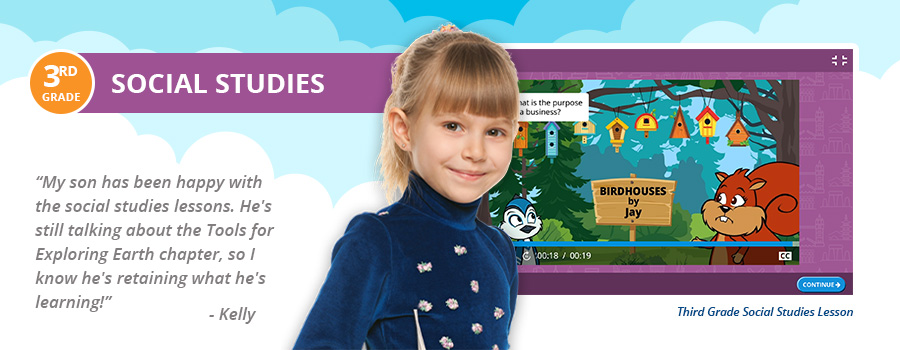
Third grade social studies involves the study of geography, history, economics, and civics. This year, students will explore topics such as Earth’s climate, natural resources, democracy and the Constitution, and federal laws, just to name a few. As they learn about historic events and explore new concepts, they’ll also learn to use tools such as maps, historical images, and primary sources to find information.
Learn more about how Time4Learning’s third grade social studies curriculum can give your child the tools to succeed.
What Do you Teach in 3rd Grade Social Studies?
Third grade social studies usually teaches students about a variety of topics including Earth’s physical features, the events that led to the U.S. Revolution, what it means to be a good citizen, and various economic systems.
Although the scope and sequence may vary, you’ll find that most 3rd grade social studies curriculum will generally be pretty similar and include lessons on the following:
- How to read maps, geographic tools, terms, etc.
- Earth’s features and locating specific places on a map
- The history of slavery as well as women’s suffrage
- The three branches of government
Learn more about Time4Learning’s third grade social studies curriculum by exploring our third grade social studies lesson plans below.
Third Grade Social Studies Objectives
By the end of third grade, students should be well versed and knowledgeable on a number of social studies topics and concepts. A comprehensive third grade social studies curriculum should help your child meet this year’s objectives as well as prepare them for next academic year.
Some of the learning targets your student should achieve include:
- Understanding and using maps
- Gaining an understanding of economic concepts (banks, development of money, production of goods)
- U.S. regions and colonial life
- The events that led to the birth of our nation
Don’t forget to look for opportunities to enhance your third grader’s social studies skills by incorporating unit studies to help you supplement your lessons. As well, making sure to include field trips into your schedule will boost your child’s learning not only in social studies but across other subjects as well.
Time4Learning’s Third Grade Social Studies Lessons
Students are introduced to geography.
Students will explain how a globe can help us understand our world.
Students will use a globe to identify the oceans and other bodies of water on Earth.
Students will use a globe to identify the continents and other land features of Earth.
Students will use a globe to recognize characteristics of major climate regions.
Students will review Vearl’s summary of information taught in the chapter and then will answer questions to check their understanding of the material.
Students are introduced to the understanding that maps are tools used to explore Earth.
Students will compare information found on globes and maps.
Students will use map features to read and understand maps.
Students will understand how GPS and satellites are used to plan routes.
Students will review Vearl’s summary of information taught in the chapter and then will answer questions to check their understanding of the material.
Students are introduced to considerations people make when deciding where to live.
Students will identify some natural resources and connect how they relate to needs.
Students will describe how the environment, people, and activities in an area can affect decisions about where to settle.
Students will identify five US regions and describe how environmental and human characteristics make states in the same region similar.
Students will review Vearl’s summary of information taught in the chapter and then will answer questions to check their understanding of the material.
Students are introduced to history.
Students explore what North America was like before Europeans arrived.
Students examine primary sources to learn about what happened in the past.
Students use primary sources to learn about the Pilgrims and their journey to and colonization of Plymouth.
Students explore the origins of and what life was like in the Middle Colonies.
Students explore the origins of and what life was like in the Southern Colonies.
Students will review Vearl’s summary of information taught in the chapter and then will answer questions to check their understanding about what was taught in the chapter.
Students are introduced to the understanding that there was a series of events that led to the building of a new nation.
Students will explain the colonists’ reactions to taxes imposed by the British government.
Students will explain how the Boston Tea Party was a protest against the British government.
Students will describe how the British responded to the Boston Tea Party.
Students will describe why it was difficult for the British to surprise the American colonists.
Students will examine how decisions about war led to the building of a new nation.
Students will review Vearl’s summary of information taught in the chapter and then will answer questions to check their understanding of the material.
Students are introduced to forms of government.
Students will explore the purpose and work of government and three different forms of government: monarchy, autocracy, and democracy.
Students will investigate the choices made to build a government for the United States, identify the three branches of the federal government, and learn about checks and balances in government.
Students locate democratic countries in the world and compare election day traditions.
Students will review Vearl’s summary of information taught in the chapter and then will answer questions to check their understanding of the material.
Students are introduced to rules and laws.
Students explore the steps needed for a bill to become a federal law.
Students learn how state governments are organized and how they make laws.
Students learn how local governments are organized and how they make laws.
Students will review Vearl’s summary of information taught in the chapter and then will answer questions to check their understanding of the material.
Students are introduced to rights and responsibilities.
Students will identify some rights that all people deserve, and their responsibilities to others.
Students will describe how the US Constitution can be changed.
Students recount instances when people were denied their rights.
Students will describe how women in the United States got the right to vote.
Students will review Vearl’s summary of information taught in the chapter and then will answer questions to check their understanding of the material.
Students are introduced to economics.
Students will explore how consumers meet their wants and needs.
Students will explore how producers offer goods and services.
Students will explore how scarcity and surplus affect economic decisions.
Students will review Vearl’s summary of information taught in the chapter and then will answer questions to check their understanding of the material.
Students will examine ways that prices affect markets.
Students will answer questions to check their understanding about the topic and lesson vocabulary.
Students will consider ways technology affects business.
Students will review Vearl’s summary of information taught in the chapter.
Students are introduced to the understanding that money can be spent or saved.
Students will discover how systems of money were developed and learn about some of the money used around the world.
Students will discover ways to save money and learn how investing works.
Students will review Vearl’s summary of information taught in the chapter and then will answer questions to check their understanding of the material.
Why Choose Time4Learning’s Third Grade Social Studies Curriculum
Social studies is often considered a boring subject for students. That’s why it’s important to choose a social studies curriculum that will engage your third grader and motivate them to learn more.
At Time4Learning we understand how important it is to foster a love for learning across all subjects and ensure students are retaining the knowledge we share with them. This is why our social studies lessons are presented in a fun way and let students progress at their own pace. One of our main goals is to ensure students gain a thorough understanding while building confidence.
Parents can focus on the “fun” part of homeschooling while Time4Learning automatically takes care of grading and recordkeeping, lesson planning, and more.
Learn more about our online third grade homeschool curriculum, designed to help your child learn and master their fundamental concepts.