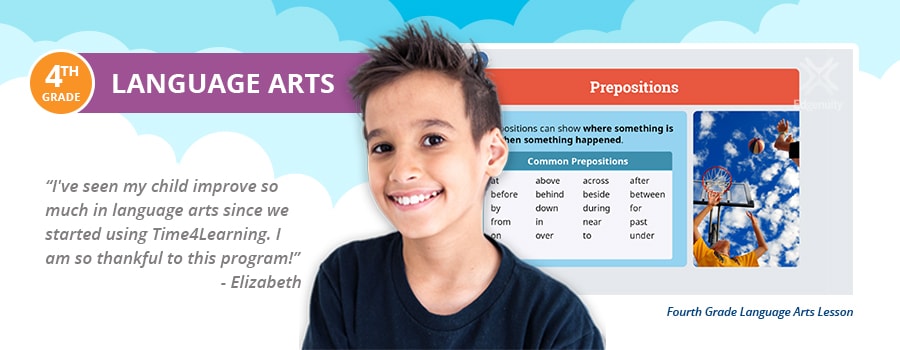
Fourth Grade Language Arts Homeschool Curriculum
A 4th grade language arts program has two primary goals: making sure your child understands what he/she is reading and being able to communicate ideas clearly. Your fourth grader will be comprehending a wide range of written texts, from articles to poems. They will also learn to summarize what they have read and share it using supporting details, facts, and examples.
What Language Arts Concepts Should a Fourth Grader Know?
By the end of fourth grade language arts, students should be able to:
- Read with a higher level of fluency and expression.
- Utilize root words, prefixes, suffixes, and context clues to analyze unfamiliar words.
- Apply comprehension strategies to literary and expository texts.
- Identify and describe the theme of a story, as well as retell story elements with details.
- Formulate multiple paragraph pieces that focus on a specific purpose or audience.
- Write chronological pieces, pieces focusing on cause and effect and pieces that draw from personal experience.
- Spell frequently used words correctly.
Discover everything that is included in Time4Learning’s fourth grade language arts scope and sequence below.
Fourth Grade Reading Goals/Objectives
Foundational skills for fourth grade readers involve making sure they are reading a wide variety of books and other written materials. They will be sharing what they are reading with others, both verbally and in writing. Your child should be reading fluently enough to read aloud comfortably as well.
Specifically, some of the objectives for this year’s reading instruction include:
- Paying close attention to the key features of what is read, and being able to share details afterward
- Comparing ideas, characters, events, and settings in stories
- Recognizing figurative language when reading (similes, metaphors, etc.)
- Learning the difference between first and third person narration
- Gaining additional skills in reading comprehension including summarizing, predicting, visualizing, questioning, and clarifying details
Fourth Grade Writing Goals/Objectives
Your fourth grader will become actively involved in the steps of the writing process this year. From prewriting to drafting to editing and revision, fourth graders will learn how to plan out their compositions and refine them.
Some of the specific writing goals our 4th grade language arts curriculum aims for this year include:
- Using research tools to investigate and write about a specific topic.
- Writing summaries or opinions of topics, using supporting details.
- Analyzing and interpreting a story they have read by writing about it.
- Writing an example news article.
Fourth Grade Grammar Goals/Objectives
In fourth grade, students learn to apply what they have learned about grammar and mechanics as they write original compositions. Our 4th grade language arts curriculum lessons focus on parts of speech, similes and metaphors, punctuation, double negatives, and spelling.
Fourth graders will continue to review the grammar rules they have learned to this point, and will add new concepts such as:
- Rules of spelling
- Proper and common nouns
- Regular and irregular verbs
- Correctly using commas in series, dates, addresses, and compound sentences
- Recognizing and avoiding double negatives
Time4Learning’s Fourth Grade Online ELA Lessons
The student will demonstrate knowledge by determining the meaning of synonyms from grade level appropriate vocabulary, by correctly choosing a given word or phrase that means the same thing.
The student will demonstrate knowledge by determining the meaning of antonyms from grade level appropriate vocabulary, by correctly choosing a given word or phrase that means the opposite.
The student will be able to analyze and determine the correct meaning of a word, based on the prefix of the root word or how the prefix is used in the context of a passage.
The student will be able to analyze and determine the correct meaning of a word, based on the suffix of the root word or how the suffix is used in the context of a passage.
The student will be able to identify and select the appropriate homophone or word that sounds the same, based on the context of a passage which fits the best meaning of the given word or phrase.
The student will be able to identify and analyze the author’s use of idioms, based on the context of a passage and how these expressions are used in literal and interpretative information.
Use the reading comprehension process skills of summarizing, predicting, visualizing, questioning, and clarifying with extensive scaffolding and support, through think aloud prompts.
Use the reading comprehension process skills of summarizing, predicting, visualizing, questioning, and clarifying with scaffolding and support, through think aloud prompts.
Use the reading comprehension process skills of summarizing, predicting, visualizing, questioning, and clarifying to independently read and comprehend texts with minimal think aloud support.
Use knowledge, information, and ideas from literary or expository texts to make inferences about the text (e.g., make inferences, draw conclusions, make generalizations, and infer sequence of events.)
Identify the main idea(s) or theme(s), distinguishing them/it from supporting details in a literary text.
Make a summary or paraphrase information from literary or expository text.
Identify plot by using story elements including the main problem and solution.
Identify the main idea(s) using the supporting details in an expository text.
Students will understand the similarities and differences between firsthand accounts and secondhand accounts of an event. They will apply these skills when reading two authentic nonfiction texts.
Students will understand the similarities and differences between firsthand accounts and secondhand accounts. They will apply these skills when reading two authentic nonfiction texts.
Students will understand the similarities and differences between firsthand accounts and secondhand accounts of an event. They will apply these skills when reading two authentic nonfiction texts.
Identify and use knowledge of the author’s purpose to comprehend the writing of a literary or expository text.
Read, interpret, and make predictions using charts, graphs, diagrams, maps or other graphic representations.
Compare and contrast characters, settings, ideas, information and/or plot within a text or between two or more genre sources (literary or expository), that includes figurative language such as similes.
Identify literary or expository text that is organized in sequential/chronological order using words (first, next, last, then, finally, etc.) or phrases (to begin with, in addition to, etc.) to signal
Distinguish between fact and opinion in an expository text.
Identify and distinguish between cause and effect in expository and literary texts.
Students will be introduced to academic words to increase language proficiency and activate background knowledge before analyzing two authentic nonfiction articles.
Students will be introduced to academic words to increase language proficiency and activate background knowledge before analyzing an authentic nonfiction article.
Students will be introduced to academic words to increase language proficiency and activate background knowledge before analyzing an authentic nonfiction article.
Students will learn how to integrate information from two sources and will apply these skills using two authentic nonfiction texts.
Students will demonstrate knowledge of comprehension skills on grade-level appropriate literary and expository passages, with questions that simulate a high-stakes assessment.
The student will learn thematic content through discovery and achieve comprehension by reading literature with emphasis on vocabulary. Authentic fiction literature is included.
Through a series of learning activities focused on discovery, recognition, and application, the student will practice language arts skills.
The student will learn thematic content through discovery, and achieve comprehension by reading literature with emphasis on vocabulary. Authentic fiction literature is included.
Through a series of learning activities focused on discovery, recognition, and application, the student will practice language arts skills.
The student will learn thematic content through discovery and achieve comprehension by reading literature with emphasis on vocabulary. Authentic nonfiction literature is included.
Through a series of learning activities focused on discovery, recognition, and application, the student will practice language arts skills.
The student will learn thematic content through discovery and achieve comprehension by reading poetry with emphasis on vocabulary. Authentic poetry is included.
Through a series of learning activities focused on discovery, recognition, and application, the student will practice language arts skills.
The student will learn thematic content through discovery, and achieve comprehension by reading literature with emphasis on vocabulary. Authentic fiction literature is included.
Through a series of learning activities focused on discovery, recognition, and application, the student will practice language arts skills.
The student will learn thematic content through discovery and achieve comprehension by reading literature with emphasis on vocabulary. Authentic fiction literature is included.
Through a series of learning activities focused on discovery, recognition, and application, the student will practice language arts skills.
The student will learn thematic content through discovery and achieve comprehension by reading literature with emphasis on vocabulary. Authentic nonfiction literature is included.
Through a series of learning activities focused on discovery, recognition, and application, the student will practice language arts skills.
Language Arts Extensions Lesson Plan – 4th Grade Curriculum
Identify examples of fact, fiction or opinion in text.
Increase personal vocabulary and enhance language use Unit 10.
Identify and correctly punctuate the four types of sentences: declarative, exclamatory, interrogative, and imperative.
Recognize the following parts of speech: proper and common nouns, regular and irregular verbs.
Recognize the following parts of speech: pronouns, adverbs, and adjectives.
Recognize the following parts of speech: interjections, conjunctions, and prepositions.
Correctly use commas in series, dates, addresses, and compound sentences.
Correctly use apostrophes in possessives and contractions.
Correctly use quotation marks when quoting direct speech.
Demonstrates ability to recognize and avoid double negatives.
Identifies and uses literary terminology (including setting, plot, character, problem, solution, theme, simile, alliteration, and metaphors).
Develop an understanding of the defining characteristics of fiction. Read the novel: Sarah Plain and Tall by Patricia MacLachlan.
Develop an understanding of the defining characteristics of biography.
Develop an understanding of the defining characteristics of poetry.
Demonstrate understanding of the elements of paragraph formation, such as indentation of the first line, use of a topic sentence, and development of a main idea.
Plan, draft, write, revise, proofread, edit, print, and share five written documents.
Write from personal experiences, thoughts, and feelings.
Produce two types of writing: a report and a response to literature. Read the novel Stone Fox by John R. Gardiner.
Use information sources to research a topic.
Develop diverse vocabulary when speaking.
Speak effectively by using proper pace, volume, stress, and enunciation, and correct pronunciation.
Demonstrate ability to listen attentively when others are speaking. (The learner will adhere to the conventions of language to communicate ideas orally, and will listen actively and critically to enhance understanding).
Scope & Sequence Copyright © 2025 Edgenuity, Inc. All rights reserved.
Why Choose Time4Learning 4th Grade Language Arts Homeschool Curriculum?
Time4Learning’s comprehensive curriculum for 4th grade language arts helps provide students with a strong foundation in reading, writing, and English language conventions. This foundation is what eventually helps students evolve into good communicators, which is key in all aspects of life.
Our homeschool language arts curriculum follows a student-paced approach that grants them the freedom to review or accelerate as needed. Thousands of families have chosen TimeLearning’s language arts curriculum for their fourth graders as either their core program or as a supplement to other programs they are using.
Learn more about our online fourth grade curriculum, designed to help your child learn and master their fundamental concepts.